

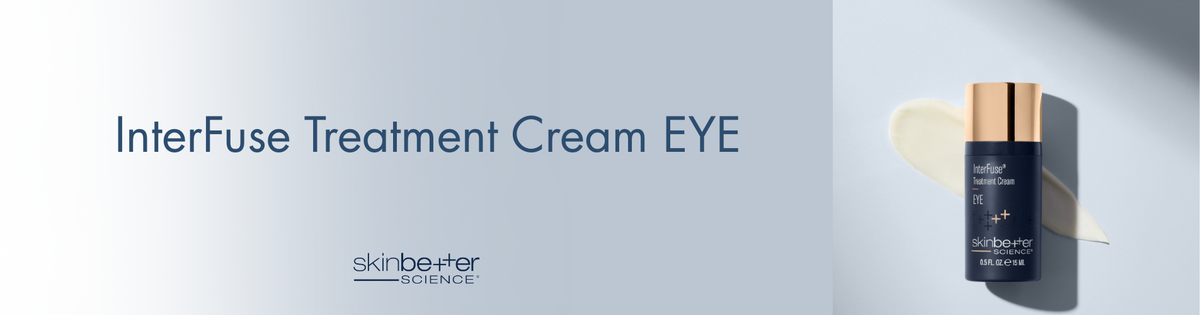
The skin around the eyes behaves differently from the rest of the face, and it tends to show change first. That makes the eye area one of the most frequently raised concerns in consultation, and one of the easiest to over-promise on. This article looks at Skinbetter Science InterFuse Treatment Cream EYE (15 mL), available in Australia through EST Skinlab. We describe the product according to what the brand and retailer state, then set that alongside the general evidence on eye area skincare, keeping the two clearly separate.
Why periorbital skin needs a different approach
Periorbital skin is measurably the thinnest on the face. A 2025 high-frequency ultrasound study in the Journal of Clinical Medicine found the upper eyelid the thinnest facial site measured, at a median of 573.5 μm, against 1,907 μm at the nasal apex (Korzekwa et al., 2025). That has two practical consequences for anyone choosing an eye cream in Australia.
First, tolerance. DermNet notes that "the thin skin of the eyelids is particularly sensitive to irritants and allergens and is thus prone to develop contact dermatitis," listing eye creams, cosmetics, sunscreens and cleansers among common triggers, along with allergens transferred by the hands (DermNet). That is the argument for a gentle eye cream routine rather than an aggressive one.
Second, appearance. A review in the Journal of Clinical and Aesthetic Dermatology attributes under-eye darkness to several overlapping causes: genetics, superficial vessels showing through thin skin, dermal melanin, post-inflammatory pigmentation, periorbital swelling, and age-related tear trough hollowing, with ultraviolet radiation aggravating it (Sarkar et al., 2016). Worth saying plainly to anyone shopping for an eye cream for dark circles: where shadowing is driven largely by anatomy, a clinical assessment is more useful than a topical product.
What Skinbetter Science InterFuse Treatment Cream EYE claims
The following comes from the EST Skinlab and Skinbetter Science product pages, presented as brand and retailer claims rather than established fact.
The product is described as "a powerful, award-winning eye cream to recharge the eye area," intended to "improve the appearance of crow's feet, wrinkles, puffiness and under-eye darkness." It comes in a 15 mL airless container, listed at $180.00 AUD at the time of writing, and EST Skinlab describes it as exclusively available in clinic (EST Skinlab). Skinbetter Science calls InterFuse "a patented technology that aids in the delivery of previously difficult-to-deliver ingredients," and states that the targeted peptide "is designed to smooth the appearance of crow's feet almost immediately." Other stated claims are a reduced appearance of under-eye puffiness through caffeine and a yeast derivative, reduced dryness, and antioxidant and brightening benefits (Skinbetter Science).
The brand highlights messenger peptides, a neuro-calming peptide, Kakadu plum extract as a vitamin C source, caffeine, niacinamide and hyaluronic acid; the published INCI list names these as palmitoyl tripeptide-38, s-Mu-conotoxin CnIIIC acetate, Terminalia ferdinandiana fruit extract, caffeine, niacinamide and sodium hyaluronate. All Skinbetter Science products are described as dermatologist tested, paraben free, fragrance free, dye free and cruelty free.
The brand reports a dermatologist-led evaluation involving 25 participants who used the product twice daily for eight weeks; detailed numerical outcomes are not published on the product page. Its awards, from InStyle (2017), Prevention (2021) and Reader's Digest (2022), reflect editorial selection rather than clinical validation.
What the general evidence says about these ingredients
This is general evidence about ingredient classes, not about this formulation. Concentrations are undisclosed, so it cannot predict what this product will do.
Niacinamide has the most consistent support. A 2024 review in Drug Delivery and Translational Research describes increased ceramide and lipid synthesis supporting the epidermal barrier, reduced melanosome transfer affecting pigmentation, and studies reporting reduced wrinkling and hyperpigmented spots in ageing skin; trials commonly used around 4 per cent (Ong and Goh, 2024).
Peptides are grouped in a Cosmetics review into signal, carrier, neurotransmitter-inhibiting and enzyme-inhibiting categories, though that review is candid that penetration is constrained by molecular size and that "the actual effect of individual peptides on the skin remains unclear" (Schagen, 2017).
Hyaluronic acid binds many times its own volume in water, though a review in Molecules notes that "the high molecular weight of HA does not allow it to penetrate the deeper layers of the skin which restricts its benefits to topical effects" (Juncan et al., 2021). Surface hydration still matters where dryness exaggerates fine lines.
Vitamin C is described in the Journal of Clinical and Aesthetic Dermatology as one of the skin's most potent antioxidants and a cofactor in collagen synthesis, though "clinical studies on the efficacy of topical formulations of vitamin C remain limited" (Al-Niaimi and Chiang, 2017). Kakadu plum fruit carries exceptionally high ascorbic acid levels, with wide variability between trees (Williams et al., 2016).
Caffeine is the ingredient most often over-claimed in eye care. A 2026 Cosmetics review discusses it in relation to circulation, lipolysis and antioxidant activity, but cautions that "heterogeneity in study design and the lack of standardised evaluation methods limit firm conclusions" (Rusu et al., 2026). An eye cream for puffiness is better framed as short-term appearance than correction, and topical caffeine is not an established treatment for eye bags or dark circles.
Australian regulation puts an eye cream on the cosmetic side of the line, where claims concern appearance rather than physiology (AICIS; TGA).
Building a gentle eye cream routine
The directions are specific: apply a rice grain amount to clean, dry skin around the under-eye area, morning and evening, and protect with sunscreen during the day. Skinbetter Science suggests applying it after InterFuse Intensive Treatment LINES.
A rice grain is a small amount by design. The American Academy of Dermatology warns that applying more than directed can cause clogged pores, blotchy skin or excessive dryness, advises introducing one new product at a time, and notes that most anti-ageing products take at least six weeks and sometimes up to three months (AAD). Worth saying plainly: "sunscreen and moisturizer are the two most-effective anti-aging products you can buy," and topical anti-ageing products "deliver modest results" (AAD).
For the daytime step, Cancer Council Australia recommends SPF 50 or 50+ broad-spectrum, water-resistant sunscreen applied 20 minutes before exposure and reapplied every two hours, alongside shade, a broad-brimmed hat and wraparound sunglasses meeting AS/NZS 1067; hat and sunglasses together can reduce UV exposure to the eyes by up to 98 per cent (Cancer Council Australia).
Sensible precautions
Patch test before committing. The AAD suggests trialling a new product on the inner forearm twice daily for four to five days before applying it to the face, and stopping anything that stings, burns or tingles, since those sensations point to irritation rather than benefit. It also notes that creams cannot reduce all signs of ageing skin, and that a dermatologist can advise where results have not appeared (AAD).
Keep product off the lid margin and out of the eye, and apply with clean hands, given how readily allergens transfer to the eyelids by touch. If the eyelids become itchy, red, scaly or swollen, discontinue and seek assessment: DermNet notes that patch testing confirms allergic contact dermatitis, and that cosmetics are best avoided while skin is inflamed (DermNet). Anyone with a history of reacting to skincare should check first. Nothing here is medical advice.
Conclusion
Periorbital skin justifies its own approach for measurable reasons: it is the thinnest on the face, prone to contact dermatitis, and under-eye darkness usually has several causes at once. Against that background, Skinbetter Science InterFuse Treatment Cream EYE is a clinic-dispensed, fragrance-free eye cream built around peptides, caffeine, niacinamide, hyaluronic acid and a vitamin C source, making appearance-level claims. Used as directed, alongside daily sun protection and realistic timelines, it suits concerns about fine lines, dryness and surface appearance rather than structural volume loss.
Because the causes differ so much between people, the most useful next step is often a conversation rather than a purchase. The team at EST Clinic offers personalised skin consultations by appointment.
FAQ
How long before I might see a change?
The brand states the targeted peptide is designed to smooth the appearance of crow's feet almost immediately, and reports an eight-week evaluation. More generally, the AAD advises that most anti-ageing products take at least six weeks, sometimes up to three months.
Is it an effective eye cream for puffiness?
The brand claims a reduced appearance of under-eye puffiness through caffeine and a yeast derivative. That is an appearance claim, and general evidence for topical caffeine is limited by inconsistent study design, so treat it as a short-term look, not a correction.
Will it work as an eye cream for dark circles?
No topical product should be presented that way. Under-eye darkness can stem from genetics, visible vessels, dermal melanin, post-inflammatory pigmentation, swelling or tear trough hollowing. Where the cause is anatomical, seek a professional assessment.
Is it suitable for sensitive skin?
The brand describes its products as dermatologist tested, fragrance free, paraben free and dye free, but no product suits everyone. Patch test first, and seek advice if you have a history of reacting to skincare or of eyelid dermatitis.
Do I still need sunscreen?
Yes. The directions specify sunscreen during the day, and UV is listed as an aggravating factor in under-eye pigmentation.
Sources
● EST Skinlab, Skinbetter Science InterFuse Treatment Cream Eye 15ml: https://estskinlab.com.au/products/skinbetter-science-interfuse-treatment-cream-eye-15ml
● EST Skinlab: https://estskinlab.com.au/
● Skinbetter Science, InterFuse Treatment Cream EYE: https://www.skinbetter.com/shop-skincare/product-category/eye-care/interfuse-treatment-cream-eye-M011.html
● Korzekwa et al., Quantitative Analysis of the Human Face Skin Thickness: A High-Frequency Ultrasound Study, Journal of Clinical Medicine, 2025: https://www.mdpi.com/2077-0383/14/23/8401
● DermNet, Eyelid contact dermatitis: https://dermnetnz.org/topics/eyelid-contact-dermatitis
● Sarkar et al., Periorbital Hyperpigmentation: A Comprehensive Review, Journal of Clinical and Aesthetic Dermatology, 2016: https://jcadonline.com/periorbital-hyperpigmentation-a-comprehensive-review/
● Ong RR and Goh CF, Niacinamide: a review on dermal delivery strategies and clinical evidence, Drug Delivery and Translational Research, 2024: https://link.springer.com/article/10.1007/s13346-024-01593-y
● Schagen SK, Topical Peptide Treatments with Effective Anti-Aging Results, Cosmetics, 2017: https://www.mdpi.com/2079-9284/4/2/16
● Juncan AM et al., Advantages of Hyaluronic Acid and Its Combination with Other Bioactive Ingredients in Cosmeceuticals, Molecules, 2021: https://www.mdpi.com/1420-3049/26/15/4429
● Al-Niaimi F and Chiang NYZ, Topical Vitamin C and the Skin, Journal of Clinical and Aesthetic Dermatology, 2017: https://jcadonline.com/topical-vitamin-c-and-the-skin-mechanisms-of-action-and-clinical-applications/
● Williams DJ et al., Organic acids in Kakadu plum (Terminalia ferdinandiana), Food Research International, 2016: https://era.dpi.qld.gov.au/id/eprint/5393/1/1-s2.0-S0963996916303180-main.pdf
● Rusu A et al., Bioactive Compounds for Topical and Minimally Invasive Cellulite Treatment and Skin Rejuvenation, Cosmetics, 2026: https://www.mdpi.com/2079-9284/13/1/35
● American Academy of Dermatology, How to select anti-aging skin care products: https://www.aad.org/public/everyday-care/skin-care-secrets/anti-aging/selecting-anti-aging-products
● American Academy of Dermatology, How to maximize results from anti-aging skin care products: https://www.aad.org/public/everyday-care/skin-care-secrets/anti-aging/maximize-anti-aging-products
● Cancer Council Australia, Be SunSmart: https://www.cancer.org.au/cancer-information/causes-and-prevention/sun-safety/be-sunsmart
● Therapeutic Goods Administration, Determining if your product is a cosmetic or therapeutic good: https://www.tga.gov.au/resources/guidance/determining-if-your-product-cosmetic-or-therapeutic-good
● Australian Industrial Chemicals Introduction Scheme (AICIS), Cosmetics and therapeutics: https://www.industrialchemicals.gov.au/cosmetics-and-soap/cosmetics-and-therapeutics


